



Interview with the Director
Mr Besuden, how did you come to make films with people with disabilities?
When I was still working in the current journalistic field, I came into contact with people we call disabled for the first time. There were actions in the city that we reported on and I quickly realised that I liked them. They are different, they are usually more honest, more open and less calculating. They also sometimes take us in other, unforeseen directions that we are not used to in this profession. I found that surprising, but also pleasant, and then every now and then I took the opportunity to make contributions for the TV regional magazine I worked for. Radio Bremen, buten un binnen.
That was so exciting for me that I continued with longer films, 30 minutes, 45 minutes and stories about them and their artistic work – about the painters, the singers, the actors. It's really impressive what is created there. And everything is always a little off the 'normal' track, always something special.
This led to the first feature film "Crazy About Paris" and that was a real breakthrough with this topic. At that time, in 2002, the term inclusion was not yet used. But the work was exactly what we call this term today.
It was also shown at the Berlinale?
It was shown as a world premiere at the Berlinale and was at least a respectable success with 280,000 viewers nationwide. Not a blockbuster, but I was very happy about this result.
You also have to finance a film like that. Is that difficult or is it easier?
No, that's difficult, and besides, it's a very unpleasant phase of filmmaking to get the money together. Filmmaking is something beautiful, something highly demanding and also fulfilling. It's wonderful to work with the actors and it's 'mostly' fun and works above all through mutual respect. I often miss that when it comes to the question of financial support, which can sometimes be simply undignified!
So many doors have to be knocked on and the people who are sitting on the money have to be convinced that this can also be something highly exciting for the audience. The common prejudice says that such actors can't do it at all, that they won't carry such long stretches in a film. It's a difficult, unpredictable terrain we're on.
These are people who more often have their own way and show it than, for example, professional actors. They are more headstrong, sometimes also more uncompromising. So, especially in the field of acting, you can confidently say that divas are everywhere.
Is it really different and more difficult in this area of production?
It's more difficult in a different way. In the professional field there are dramas, here there are also dramas. I don't think you have to judge that at all, but here they are sometimes very different, different from what you had imagined before. And that only works with a lot of understanding, with calm and usually best of all with humour and a good atmosphere on the set. That is indeed always a key.
In fact, it is a different way of working together, it is sometimes difficult, sometimes almost hopeless, but all in all it is demanding, challenging and also leads everyone involved to their own horizons. But that's also where the most interesting encounters and work results come from. It is always more boring in the middle of the cake than at the edge. That's where the changes begin. It is the same in society.
What does this look like in detail?
The trickiest thing about working with these actors is that you meet their acting range. Because it's actually often smaller here than with professional actors. But it is there and if you find it and use it in the right place, you hardly see a difference in the result.
Moreover, it is rather the case that these actors have a considerable advantage over the others because they come across much more authentically and that makes them really special actors whose effect is often quite amazing later on the screen.
The work is also different in that working on the script and working with actors are very intertwined. The script is never finished when I start rehearsing. During rehearsals, new possibilities always arise for this particular person in the role he or she is supposed to take on, so the script is then worked on again and again. The person then feels more and more comfortable in the role and is eventually at home in it. The final touches to the character always work together with the actor who is to carry the character.
And that is actually a very different kind of work than in the so-called professional field. It's also sometimes more delicate, but it's always special. That's why we always call them the special actors on set. That not only sounds better than saying the disabled actors. It's also more accurate and respectful.
How is that received by the audience, especially by the audience that doesn't come from this area, i.e. the normal audience? Do they also dare to criticise?
The situation among spectators is similar to that in society. Everyone thinks about these people in a certain way, usually with more or rarely less prejudice. Most people generally prefer not to have anything to do with this clientele, if they can help it.
So if you meet them at the tram stop, for example, you also like to walk away a bit, inconspicuously of course, they could touch you. Some even just take you in their arms. That would be a scary idea. So it's best to distance myself from them and have nothing to do with them. Then I don't have to behave. That's exactly the problem why normal viewers, I'll call them that now, don't like to go to such films. If for some reason you have crossed the threshold, then we almost always get them excited about the film and also about the actors, but for that they first have to go in.
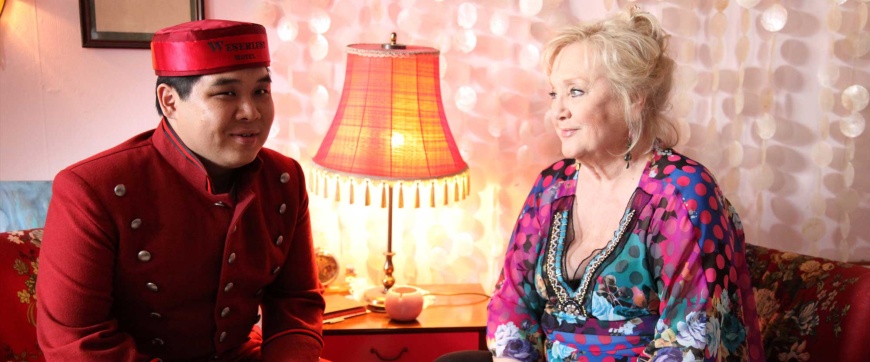
It's a bit like the devil and holy water, both of which are difficult to make compatible, but we gladly accept the challenge. "Weserlust Hotel" is wonderfully suited to go along and cross this threshold. No problem is left out, but everything happens in a charming, honest and rousing way.
You have made feature films and documentaries on this topic. Which format is better suited to this topic?
That's difficult, I can't really decide. We have just done both with "Weserlust Hotel" and "All inclusive". I also enjoy both very much. But, to be honest, at the end of the day, the documentary is perhaps even the more interesting film for the audience. They learn more about the people they see on the screen. It's less about the play and the role, it's more about the concrete person and I think that's actually the more interesting part.
This real person talks about their life and what they do and what they want, what they laugh about and what they are sad about. To bring out such things in a documentary and show them to the viewers is exciting. Especially for those who don't want to have anything to do with the subject. Then something can open up and at best lead to the realisation: Oh, I haven't seen it like that before and then I don't need to be afraid of the people and not run away from them! That would be the optimal result for us and our work.
The interview was conducted by Beatrice Behn during the Berlin International Film Festival 2017 for "FilmFestSpezial: Das Arthouse-Filmmagazin".